
Signal
Before you build a team of agents, make one agent stop correctly
If your first agent doesn't know when to stop, adding a second one multiplies the cleanup, not the output.
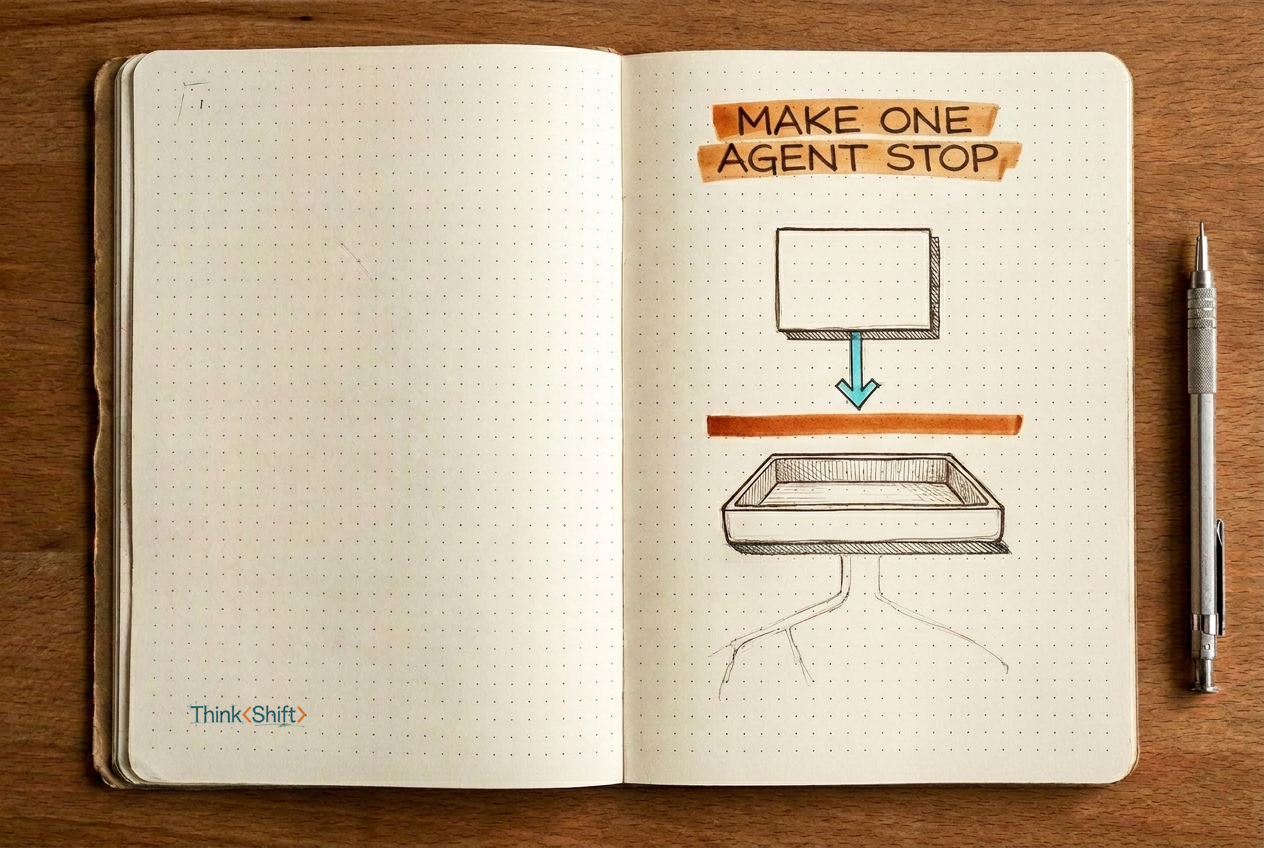
The move Before you add a second agent, write a single-agent brief for the first one: trigger, expected output, stop rule, and fail state. The boundary has to be visible before anything connects to the agent's output.
The short version: If your first agent writes a confident draft when it should have stopped, every agent you connect to it acts on that bad output. Before you scale, write a four-line brief for the first agent: trigger, expected output, stop rule, fail state. The stop rule is the whole point.
Your first agent works. It pulls new entries from a shared form and drafts a follow-up email. Twenty minutes saved, every time.
Now you're planning the next step: a second agent to categorize the entries, a third to route them, maybe a coordinator to manage the handoffs between all three.
Before you connect anything, go back to the first one. What does it do when it hits an input it can't handle?
If it writes a confident-sounding draft anyway, you don't have a working agent. You have a source of bad output that looks like good output. Every agent you connect to it treats that bad draft as a real one and keeps going.
The first thing to prove about an agent isn't what it can do. It's whether it knows when to stop.
An agent without a stop rule doesn't fail loudly. It hands something plausible to the next step, which acts on it, which hands the result forward. By the time a person spots the problem, three steps have run on a bad input.
The move
Before you add a second agent, write a one-paragraph brief for the first one. Four lines:
- Trigger: What starts it. ("A new row in the vendor intake sheet.")
- Expected output: What it hands back. ("A draft follow-up email, saved to Drafts, not sent.")
- Stop rule: When it hands the work to a person instead of continuing. ("If the form is missing a company name or the request doesn't match one of three service tiers, flag it and stop.")
- Fail state: What a bad run looks like. ("It drafts a reply guessing the service tier. The vendor gets a price quote for the wrong package.")
Why this helps
The brief makes the boundary visible before anything connects to the agent's output.
What stays human
You decide where "good enough to act on" ends. The agent runs the steps.