Prompt You'll Actually Use
Ask AI one question before you trust a polished draft
A draft can sound finished while the thinking underneath is still thin. Tag each sentence as explanation, assertion, evidence, or unsupported claim.
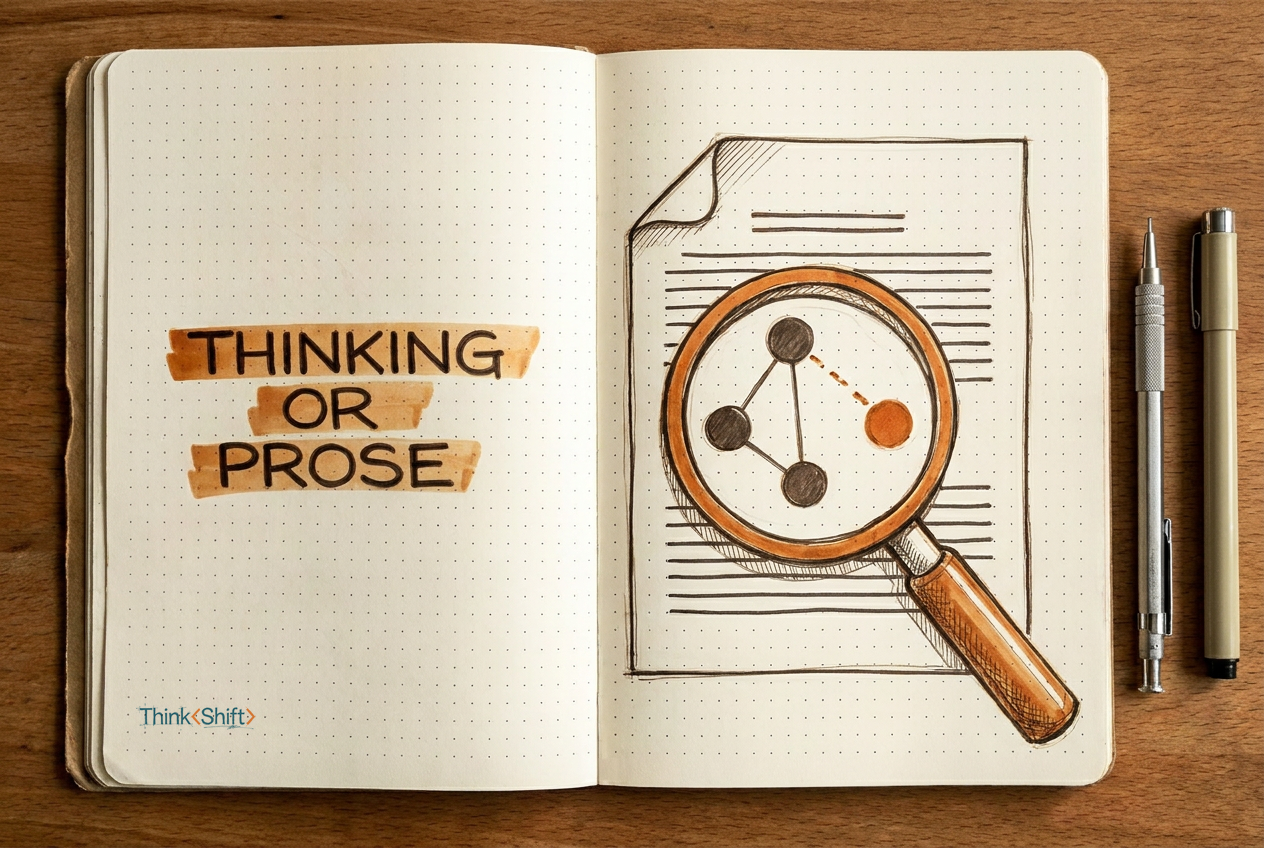
The move Before you send a polished draft, paste it into AI and ask it to tag each sentence as explanation, assertion, evidence, or unsupported claim. Fix the unsupported ones. Don't let it rewrite.
The short version: Asking AI "is this good?" checks the writing, not the thinking. Ask it to tag each sentence by what it actually is. The ones labeled "unsupported" are where your client will push back first.
Your recommendation memo reads clean. Clear sentences, specific language, ready to send.
Before you do, ask AI one question that isn't about the writing.
When you paste a draft into AI, the instinct is to ask "is this good?" or "make it better." AI obliges: it smooths grammar, warms tone, tells you it reads great. None of that checks whether your thinking is finished.
Polished language hides unfinished thinking better than bad language does.
A confident sentence can sit on a claim you haven't backed up. The polish makes that gap harder to spot, not easier.
The move
Paste the draft and ask AI to tag each sentence, not improve it.
Read this [recommendation memo / proposal / project update]. Mark each sentence
with one label:

- EXPLANATION: restates or clarifies something already established
- ASSERTION: states a position or recommendation
- EVIDENCE: cites a specific fact, number, example, or source
- UNSUPPORTED: makes a claim with no evidence behind it in this document

List only the sentences you labeled UNSUPPORTED, with a one-line note on what
evidence is missing. If you aren't sure about a label, say so.

[Paste the full document here]
Filled in, it looks like this:
Read this recommendation memo for my client. Mark each sentence with one label:

- EXPLANATION: restates or clarifies something already established
- ASSERTION: states a position or recommendation
- EVIDENCE: cites a specific fact, number, example, or source
- UNSUPPORTED: makes a claim with no evidence behind it in this document

List only the sentences you labeled UNSUPPORTED, with a one-line note on what
evidence is missing. If you aren't sure about a label, say so.

We recommend switching to quarterly billing for mid-tier accounts. Based on
internal conversations, this approach reduces churn by roughly 20%. The team
is aligned on moving forward. Implementation would begin in Q1 and the
transition cost is minimal.
The tag check returns three gaps:
UNSUPPORTED: "This approach reduces churn by roughly 20%."
Missing: source for the 20% figure. Is this from internal data, a vendor benchmark, or an estimate?UNSUPPORTED: "The team is aligned on moving forward."
Missing: evidence of alignment. A meeting note, a vote, or a documented sign-off.UNSUPPORTED: "The transition cost is minimal."
Missing: any cost figure or comparison. "Minimal" relative to what?
Those three sentences read fine in a polished memo. They look thin only when someone labels them.
Why this helps: you aren't editing for tone. You're finding the sentences that have nothing behind them. Those are the ones your client will ask about first.
One catch
The labels are a starting checklist, not a verdict. AI can flag a sentence you can defend from memory or a conversation it hasn't seen. You decide which gaps to fill before you send.
Try it this week: Before you send your next recommendation, run the tag check. Fix the one unsupported sentence that carries the most weight. If you send these regularly, save the prompt in a Project so the check is always ready.