Work IQ
Your presentation is a vending machine
Dopamine tracks anticipation, not the payoff. Your agenda slide gives it away.
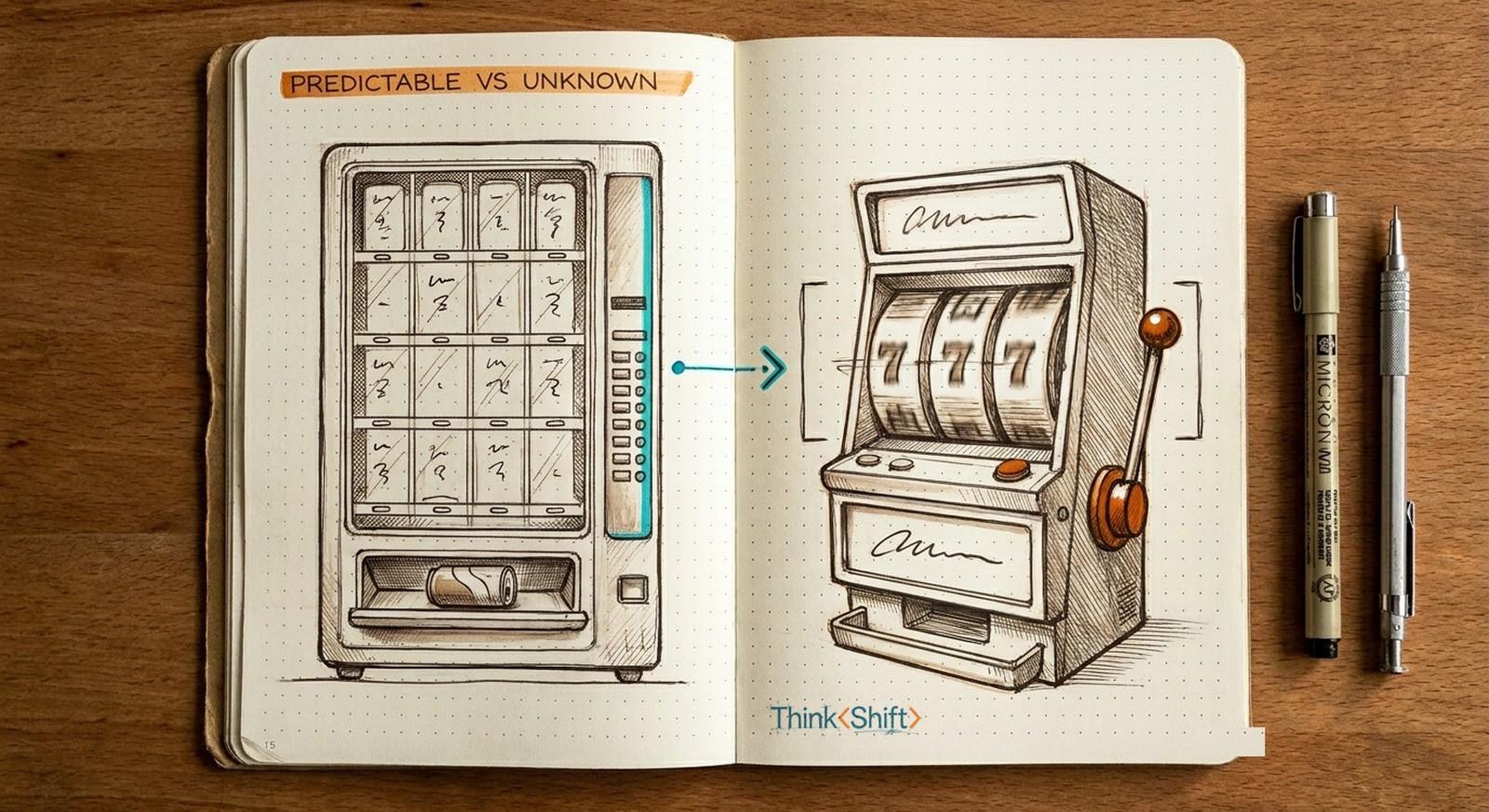
The move Open on the stakes, then keep toggling between how things are and how they could be, so a gap stays open until the end.
The short version: A talk loses the audience because it's predictable, not underprepared. Dopamine tracks anticipation, not the payoff, so a gap has to stay open the whole way. The fix is a learnable rhythm: open on the stakes, then keep toggling between how things are and how they could be. AI can restructure a talk toward that goal once you name it; the stance and the taste stay yours.
You're twenty minutes into the talk you spent weeks preparing and... you're losing them.
On a webinar you watch the attendee count slide. In a conference room the laptops creep open and the back rows drop to their phones. You opened the way every coach teaches: a clean agenda slide, the three things you'd cover. And somewhere after point two the room checked out.
It isn't polish or preparation
You could blame the slides, your delivery, or the after-lunch slot. But that same month a colleague gave a rougher, messier talk and people stayed to the end and quoted it for weeks. So the problem isn't polish or preparation. Something else decides whether a room stays, and it isn't what you've been fixing.
What actually holds a room: anticipation
It's not the payoff, it's the wait for the payoff. Dopamine, the chemical everyone files under reward, doesn't actually fire on the reward. It fires on the anticipation of one and spikes hardest when the result breaks what your brain predicted. That's why a slot machine is compulsive and a vending machine is boring: similar payout mechanism, but one keeps you guessing.
An agenda slide is pure predictability. It hands the room the ending; everything after only confirms it.
Certainty is boring at the level of brain chemistry.
The part that stings: the habit you're proud of is what emptied the room. "Tell them what you'll tell them" is a vending machine with a script. People don't stay for what they can already predict.
The fix: a rhythm you can learn (AI handles the grunt work)
The fix isn't dependent on a talent you were born without. It's a rhythm anyone can learn.
The best talks all move the same way, something Nancy Duarte mapped across hundreds of them: open on the stakes, flip to what could be, sharpen the problem, then fill in the fix. You keep the room swinging between how things are and how they could be, so a gap stays open the whole way and closes only at the end. That back-and-forth is the pull and it's what your messy colleague did on instinct.
Here's where AI earns its place. As Dan Martell frames it in his 10-80-10 principle, the first ten percent is yours, the last ten is yours, and AI takes the eighty in between. The first ten is your stance, the point of view and the stakes. The last ten is the call on what actually holds. The eighty in the middle, reordering and finding where the tension sags, is the work AI is good at. Give it the target:
Here's my talk outline: [paste it]

- Name my point of view in one line, and what's at stake if they ignore it.
- Label each section "how things are now" or "how it could be," and flag where I sit too long on one side.
- Reorder it to keep switching between the two, holding a gap open until the end.
- Then suggest one moment they'll remember, and where to put it.
What comes back will look more finished than it is, so the last read stays yours. AI carries that middle eighty faster than you could and every pass teaches you the pattern. A few rounds in, the rhythm stops being the prompt's. It's yours.
One place this flips
All of this flips the moment people follow steps in real time. In a workshop or a live how-to, give them the agenda up front. Save the rhythm for when you need a room to care, not just follow along.
Make them wait
People don't stay for what they can already predict.
So next time, don't reach for the agenda. Reach for the stakes and make the room wait. You were never a worse presenter than the naturals. You just handed over the ending before you began.